Norway and Colombia have some similarities and differences (you might think that there are more differences). Of course, some impact can happens when it is compare a developed contry, part of the old continent, with a simple developing country of South America. I use two different models to have a better comparison and conclude what of it is better. Let’s continue!
Hofstede model
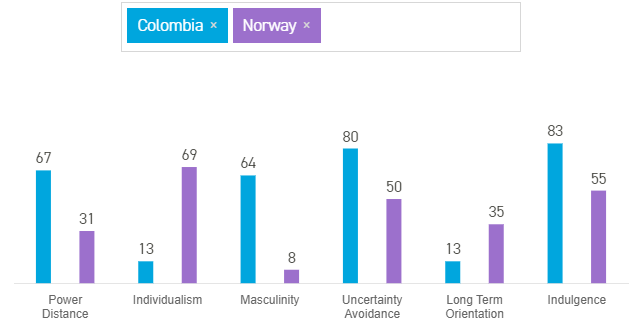
Figure 1. Scores of Norway and Colombia in a scale from 0 to 100 in different aspects as a general assumption based on the majority[1].
As shown in the chart the higher values reached by both countries are Uncertainty Avoidance and Indulgence. Being higher by 30 and 28 points respectively Colombia (See Figure 1). This means that in Colombia the people have more rigid codes of belief and behaviour and are intolerant of unorthodox behabiour and ideas. Instead, in Norway there is focus on planning, and they can be altered at short notice and improvisations made. Emotions are barely shown in Norway; people are fairly relaxed and not adverse to taking risks. Regarding Indulgence again Colombia is over Norway, due we are more disposed to set free the natural human drives related to enjoying life and having fun. Norwegian are quite more restraint and suppresses that impulses of immediate gratification.
The higher contrast is find in masculinity and individualism. Here in Colombia, we are driven by competition, achievement, and success, with success being defined by the best in field / winner – a value system that starts in school and continues throughout organizational life. Also, the people are more male chauvinist and the women have less opportunities to get a important position in a company and have less pay for the same job. Opposed to Norway, which is the second most femenine society (after the Swedes), where the people are focus on well-being, and status is not shown. Societal solidarity in life take more important; work to live and always do your best. Regarding individualism, Colombians are much more collectivistic than the Norwegian, so we have a preference for a tightly-knit framework in society in which individuals can expect their members of a particular in-group to look after them in exchange for unquestioning loyalty.
Finally, attending to Power Distance Colombians are submissive and accept the hierarchical order of the power, in contrast to Norwegian who strive to equalise the distribution of power and demand justification for inequalities of power. In the other hand, Long Term Orientiation is kind of short in Colombia, because as usual the people does not thrift or efforts in modern education as a way to prepare for the future. This pragmatic approach is most valorated in Norway.
Lweis model
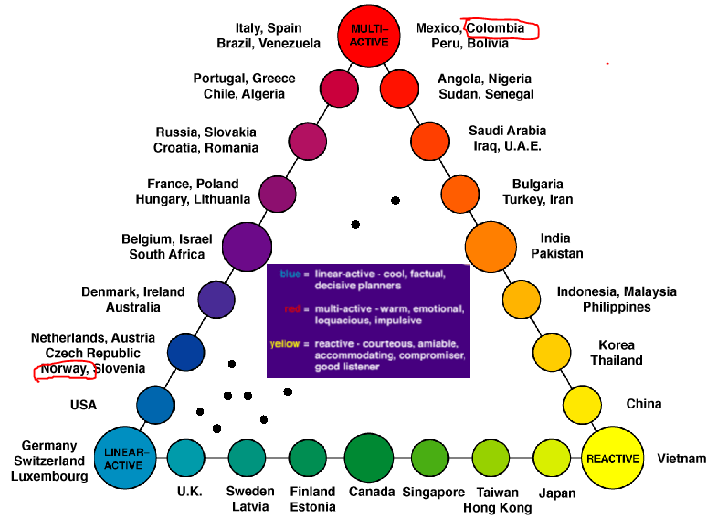
Figure 2. Position of Norway and Colombia in the ternary classification of the Lewis Model, with the meaning of the color scales of the vertices of the triangle in the middle. Modified from [2].
Both Colombia and Norway represent two total and almost opposite characteristics according to the Lewis model. Being Norwegian linear-active behind only by Americans, germans, sweaters, and Luxembourgers. On the other hand, Colombians are purely multi-active and a little bit reactive. This means that while Norwegian does one thing at a time, plans step by step, talk half of the time and are polite but direct. Whilst Colombian does several things at once, plans a grand outline only, talk most of the time and are emotional. This creates the conception that Norwegian have more value to the time, and that is demonstrated in punctuality and they dislike losing face that Norwegian have. Opposite to Colombian that thinks thas time is flexible and always has good excuses. The same happens with the truth, that also can be flexible, because they confront emotionally and feelings are before facts. Instead, Norwegian confront more logic and are stick to facts. Last but not least, Norwegian separate social and professional life, since Colombian mix these two worlds with nepotism and making bonds with work partners. Even though Norway and Colombia could share some aspects, they are so much different.
After doing this comparison with these two different models, I can say that both of them are trustworthy and give you good results. But if I have to choose one of it, I will go with the Hofstede method, because even though is less general, It gives you to much more information, also how many results that help you to value the perceptions and behaviors of each country and culture in a more precise way. Besides, the Lewis model has some troubles to define culture countries that are in a middle place of the triangle or a point between the three vertexes, making more difficult to get reliable results.
References
 AbiamRamosEnglish814